If you’ve never heard of Oktoberfest – firstly, where have you been? What started as a royal wedding celebration in Munich over 200 years ago has grown into the world’s biggest beer festival, drawing millions of visitors to the Bavarian capital every year for steins of beer, traditional food, live music and a whole lot of celebrating.
But Oktoberfest hasn’t always been the beer-soaked celebration we know today. Its story starts with a royal wedding, a horse race and one very big public party. Over the years, the festival grew into the spectacular celebration of Bavarian culture that takes over Munich every autumn – and its influence has spread far beyond Germany.
So, how did we go from a royal wedding in 1810 to steins, schnitzels and brass bands? And what exactly is a Marzen beer? Let’s get into it.

The first Oktoberfest was held on the 12th of October in 1810 to celebrate the wedding of Crown Prince Ludwig and Princess Therese of Saxony-Hildburghausen. Munich officials invited the public to join the celebrations on fields just outside of the city walls.
This site was named Theresienwiese, meaning ‘Therese’s Meadow’. The name stuck, and to this day the Oktoberfest site is affectionately named Wiesn.
The original celebration looked a little different from the Oktoberfest we know today. The main event was a horse race, held in honour of the royal wedding, and it proved so popular that it was repeated the following year. From there, Oktoberfest became an annual celebration, gradually growing bigger and adding more attractions and entertainment.
By 1814, visitors could enjoy skittles, swings and climbing poles, while carnival booths began appearing in 1818. Food also became an increasingly important part of the festivities with the first bratwurst stalls arriving in 1881.
By 1887, the traditional brewery-dray parade became part of the official opening celebrations, bringing Munich’s breweries to the heart of the festival. As Oktoberfest continued to grow, the small carnival booths were gradually replaced by the enormous beer halls we associate with the festival today.

Today, beer is at the heart of Oktoberfest. The festival is famously associated with Munich’s six traditional breweries each
Beer might not have been the reason Oktoberfest began, but it certainly didn’t take long for it to become one of the festival’s defining features.
Today, beer is at the heart of Oktoberfest. The Munich festival is famous for its six traditional breweries, enormous beer halls and, of course, the litre stein of beer being raised across the Wiesn.
But Oktoberfest beer has its own story – from the traditional Marzen style to the paler golden lagers served at the festival today.
So, what exactly is a Marzen? And why has it become so closely tied to Oktoberfest?
Marzen is a traditional German lager with roots dating back to the days when Bavarian brewing regulations restricted brewing during the summer months,
The beer was traditionally brewed in March – hence Marzen (German for … March) – and made slightly stronger and more robust so it could be stored through the summer. When autumn arrived, the remaining beer could be enjoyed as part of the harvest celebrations.
Traditionally, Marzen is known for its deeper amber-gold colour, malty character and smooth, clean finish. It’s richer than your typical pale lager, but still wonderfully drinkable – exactly the sort of beer you can imagine filling a stein with.
But the story of traditional German beer goes back even further, to a rather famous bit of brewing legislation: the Reinheitsgebot.
Introduced in Bavaria in 1516, the Reinheitsgebot – often referred to as Germany’s Beer Purity Law – stated that beer could only be brewed using three ingredients: water, barley and hops.
There was more to the law than making sure everyone was drinking ‘pure’ beer. One of its aims was to protect the supply of wheat and rye for breadmaking. By restricting beer production to barley, the law helped prevent brewers from competing with bakers for grains that were needed to make affordable bread.
And you might be thinking: hang on … what about German wheat beer?
Quite right.
There was, as it turns out, an exception to the rule. The Degenbergers, an aristocratic Bavarian family, were granted special privilege by Duke Wilhelm IV to brew and sell wheat beer, partly because it was a favourite at the royal court. The privilege eventually passed beyond the aristocracy, and by 1802 the right to brew wheat beer had been opened up to private brewers.
So, while the Reinheitsgebot helped cement barley’s place in German brewing, German beer history has never quite been as straightforward as three ingredients on a list.
And that brings us back to Marzen. Its malt-forward character, traditional brewing methods and deep roots in Bavarian beer culture make it one of the styles most closely associated with the history of Oktoberfest.
While Marzen remains a classic, the beer served at the modern Munich festival has evolved over time. Today’s Oktoberfestbier is generally lighter and more golden than the Marzen-stle beers traditionally associated with the festical.
So, while Marzen might be the historical classic, Oktoberfest beer has certainly moved with the times.
And that brings us to the important bit … what are we drinking?
For our Oktoberfest, we’ve gone all in on the beer, bringing all of Munich’s Big Six brewered and specially selected bottles to our already extensive line-up of taps and tanks.
There are traditional styles to discover, plenty of German character and a whole lot of choice for anyone who likes their beer cold, crisp and ready for a proper glug.
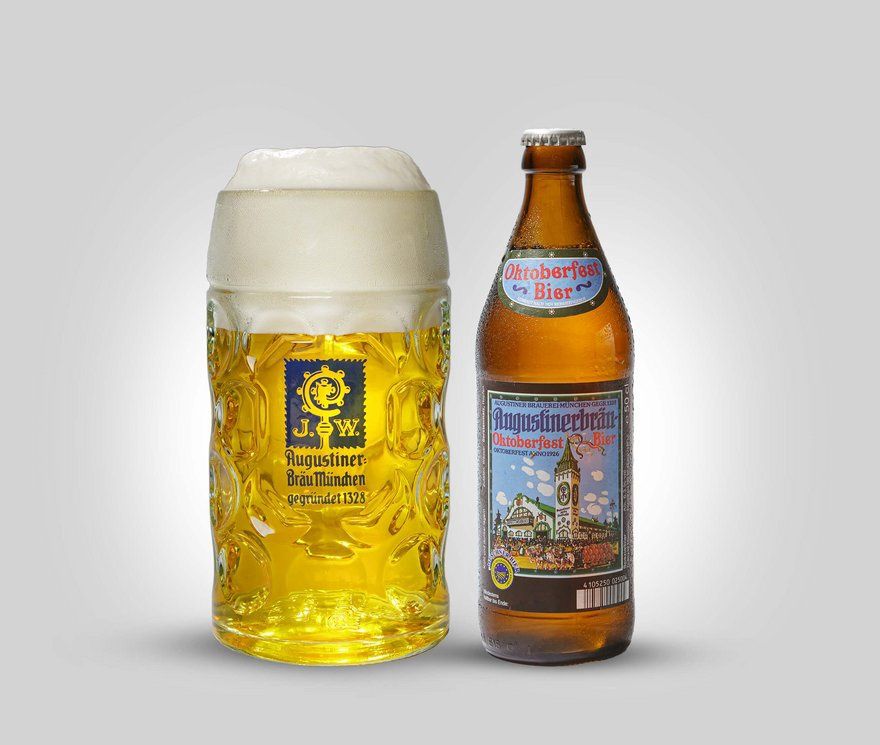
The monks of the Augustinian order founded their brewery in 1328, which still exists today and is the oldest in existence within Munich’s city limits. In fact, they supplied beer to the Bavarian Royal Wittelsbach family for 261 years until our friend Duke Wilhelm’s son founded his own court brewery, the Hofbrauhaus. It is not known when Augustiner beer was first featured at Oktoberfest, but the first record of an Augustiner beer stall is featured on a picture dating from 1867.
Augustiner remains the only brewery (of the Big Six at least) to exclusively pour from their wooden barrels.
6.3% ABV
Character and Tasting Notes: smooth, rich malt, soft sweetness, clean finish, traditional
Hacker was founded in 1417, nearly a century before the enactment of the Reinheitsgebot law. In the 18th century, it developed into Munich’s leading brewery under the couple Joseph Pschorr and Maria Theresia Hacker. Hacker and Pschorr were later run as separate breweries by their sons and have only been a joint brand again since 1972.
5.9% ABV
Character and Tasting Notes: light, crisp, balanced, gentle malt, bread crust, refreshing
Available in: bottles and on draught

Hofbräu was founded in 1589 as a ducal brewery under Wilhelm V. Since 1939, the company has been run as a state-owned enterprise. The Hof (court) comes from the brewery’s history as a royal brewery in the Kingdom of Bavaria.
6.0 % ABV
Character and Tasting Notes: rich, hoppy, full-bodied, honey, caramel
Available in: bottles and on draught

The brewery probably dates back to the late 14th century, but the name Löwenbräu first appeared in Munich’s beer brewing directory in 1746 and has been served at every Oktoberfest in Munich since the festival began in 1810.
6.1% ABV
Character and Tasting Notes: malty, rounded, balanced, mild bitterness, clean finish
Available in: bottles and draught

In 1634, the monks of the Paulaner Order served their first own beer, making Paulaner the youngest of the breweries serving beer at the Oktoberfest. At first, Paulaner beer was only served to the public on festive days, otherwise it was reserved for the monks. However, the bock-style beer based on a recipe by Brother Barnabas quickly became extremely popular among all Munich beer drinkers.
5.9% ABV
Character and Tasting Notes: smooth, balanced, drinkable, soft malt, light sweetness, crisp finish
Available in: bottles and on draught

The Spatenbrauerei was founded in 1397. Spaten has the honour of being the first brewery to launch “Münchner Hell” on the market in 1894 – a real bestseller to this day.

Whether you’re here for a traditional German lager, fancy getting stuck into a Märzen or simply want to work your way through the selection, there’s plenty to keep your stein topped up.

You don’t need to travel all the way to Munich to get your Oktoberfest fix. Every year, we bring our own take on the Bavarian tradition to the heart o Edinburgh, transforming our Beer Palace into a full-blown Oktoberfest celebration.
For 2026, Brewhemia’s Oktoberfest runs from the 19th of September to the 4th of October, bringing steins, schnitzels, authentic wursts, Bavarian beer and plenty of entertainment to Market Street, a mere stones throw from Waverly Station.
But our Oktoberfest isn’t simply about recreating what’s happening in Munich. We’ve taken the traditions we love and given them a distinctly Brewhemian twist.
The beer is a big part of it, of course. So is the food, with alpine-inspired dishes and proper Oktoberfest favourites made for sharing an serious feasting. Then there’s the entertainment – because what’s Oktoberfest without a brass band … or four?
Throughout the festival, our Beer Palace will be packed with lie brass bands, bringing Bavarian twists on party anthems and plenty of oompah to Edinburgh. Expect dancing on the benches, steins in the air, immersive entertainment and the sort of atmosphere that makes it incredibly difficult to sit quietly with your pint.
There’ll be schnapps served in a ski, cocktails, tank-fresh beer and plenty of opportunities to get involved in the celebrations, whether you’re joining us for a big night out, a Bavarian feast or simply fancy experiencing Oktoberfest in Edinburgh for yourself.
It’s got the traditions of the of the original, the beer to match and a healthy dose of Brewhemia thrown in for good measure.
From its beginnings as a royal wedding celebration in 1810 to the world’s biggest beer fstival toay, Oktoberfest has spent more than two centuries getting bigger, brasssier, and thankfully, beerier.
And this September, we’re bringing a whole lot of that to Edinburgh.
Brewhemia’s Oktoberfest runs from the 19th of September to the 4th of October 2026. All the information, including entertainment and reservations can be found here.
Steins at the ready. Prost!


